

The Nedousa Carnival


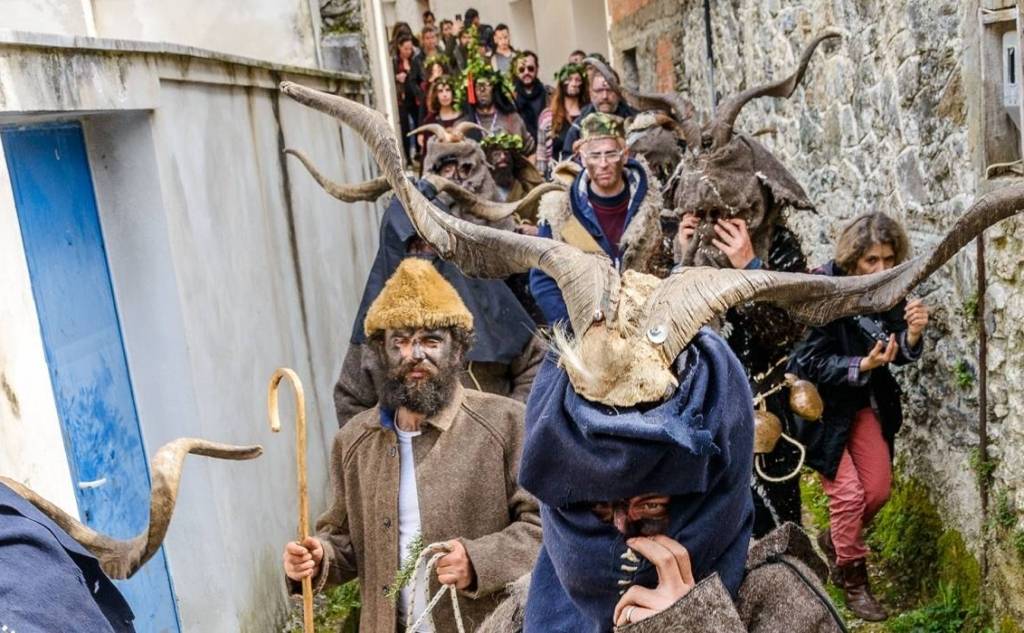
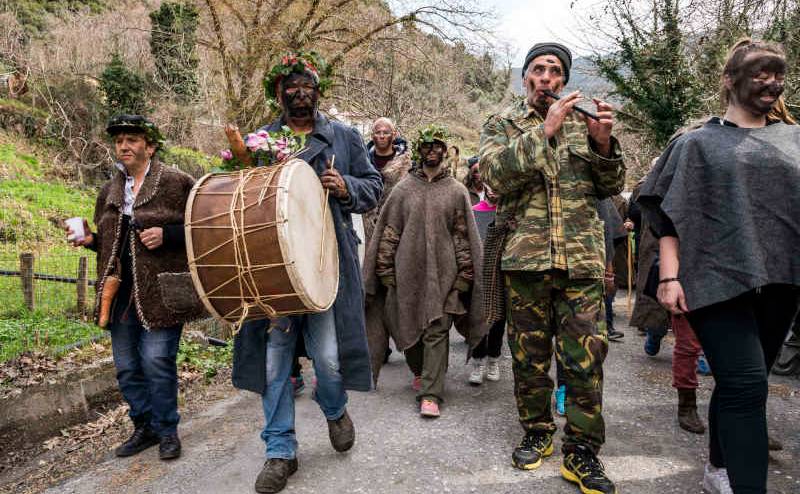
The Nedousa Carnival takes place every year on Ash Monday in the green village of the same name (19 kilometres from Kalamata). It is an authentic rural event of auspiciousness (a type of "folk theatre") consisting of a series of acts and roots in the ancient Dionysian cult. In the Nedousa Carnival (known as "Moutzourodeftera"), there are no organisers and spectators in the classical sense, and everyone participates equally in a centuries-old custom that has withstood the passage of time. Throughout the events, two traditional instruments, which originate from antiquity, sound: the drum made of animal skins and the reed flute ("tsafaraki"), which follow the theme, known as "patinada". At the entrance to the village, visitors are required to paint their faces with oven soot or charcoal to ward off the evil eye ("moutzouroma"). At the same time, the residents (dressed in animal skins and bells) pour out into the streets in a day-long event with apparent elements of Dionysian worship.
The primary purpose of the rural carnival of Nedousa is to ensure euveteria, which means "good year" (eu + year), and fertility, not only of the residents but also of the animals and farms of the village. In fact, the residents believe that if the carnival is not held for a year, "it will be bad for the village". Euveteria events occur in early March since, until 152 BC, the beginning of March was also the beginning of the ten-month year. This is followed by the "Alarm", the troupe's visit to all the village houses to exchange wishes and collect food (bean stew, halva, lagana, olives) that will be eaten later in a group meal. Passing through the square, those in goat-like disguises engage in mock battles accompanied by the sounds of bells.
The events that make up the agricultural carnival follow three acts: "Ploughing-Sowing", "Wedding" and "Death-Funeral-Resurrection". The most devout moment of the day is the "Ploughing", where the ancient plough "ploughs" the village square three times in a circle (counterclockwise) while the troupe sows seeds and buries them. The "Wedding", a regular part of the procession, causes plenty of laughter since the main characters are men dressed as women. Everyone's wishes for the "newlyweds" are for good childbearing, which is why, as soon as the wedding ceremony is complete, the "couple" immediately begin their efforts on the "thrice-plowed" land. At this point, it is worth noting the description of a similar act by the epic poet Hesiod 2,700 years ago:
"Demeter gave birth to Ploutis
the divine goddess
with the hero Iasius, merging
in sweet love
on a three-leaved field..."
The third act (that of "Death-Funeral-Resurrection") begins with the transfer of the "dead" in an improvised coffin that is placed in the middle of the square. The deceased is always a young man who is killed "so as not to die of senile weakness" accompanied by heartbreaking "obituaries". This entire process is, of course, subject to the ancient belief in the "annual demon", that is, in vegetation, which also dies and is reborn once a year. Specifically, according to tradition, he was the demon of fertility and the personification of time. A little later, the "Resurrection" of the "dead" takes place after the constant admonitions of those present, where it manifests itself in a joyful dance that symbolises the resurrection of nature and the coming of spring. Throughout the event, obscenity and depictions of genitals are the dominant elements, as is the case in all festivals that aim at the birth of people and fruits. Finally, G. Aikaterinidis' note (Dr. of Folklore and former Director of Research at the Folklore Centre of the Academy of Athens) regarding the value of the event: "With the Carnival of Nedousa, the familiar map of events is expanded and enriched, which can lead to interpretations of related events, which complement those already known or which can revise those that have prevailed to this day, regarding, for example, their initial origin and subsequent spread in the Greek historical space."