Heterotopia Project Opening

Spread the word


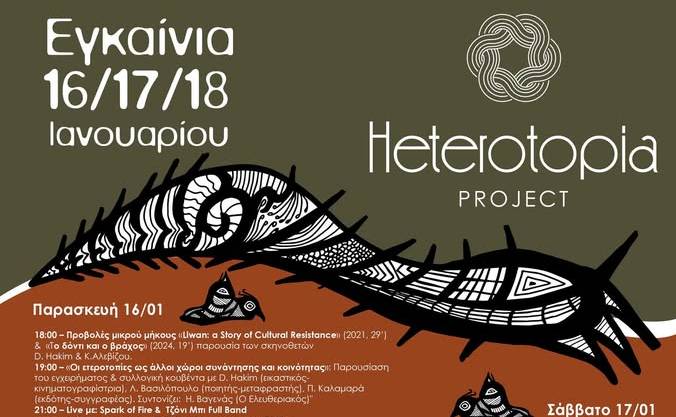
Heterotopia: a real, “other space” within society, where the dominant relations of space, time and community are suspended, reversed or reinterpreted.
In this Foucauldian sense, the Heterotopia Project is born in the Stoa Londou as a collaborative bookstore-cafe/reading room-multi-space, organised as a Social Cooperative Enterprise for the Integration of Vulnerable Groups. We operate horizontally through an assembly of workers; we reinvest income in the project and return surplus value to the community.
We invite you to our three-day inaugural festival featuring screenings, discussions, book presentations, music, communal cuisine, and activities for young and old.
See you there!
DETAILED PROGRAMME
FRIDAY 16/01
18:00 - Short film screenings with the presence of the creators: “Liwan: a Story of Cultural Resistance” (2021, 29') & “The Tooth and the Rock” (2024, 19').
Two films that ideally open the three-day festival, as they speak to place as a field of conflict and memory, to the “development” that alters lives, and to cultural resistance as an everyday, collective act.
“Liwan: a Story of Cultural Resistance” (Doris Hakim) is a documentary of cultural resistance in Nazareth: a “cultural café” that opens in a neighbourhood wounded by a Zionist “redevelopment” plan, and manages—with persistence and community—to become a core of revitalisation of public space and Palestinian identity.
“Tooth and the Rock” (Kostís Alevizos) brings us to Pylos, where a return becomes an occasion to reveal the rapid tourist transformation of the place; a story about who has the right to the shade of a tree, who “fits in” the new reality, and how old bonds are revived when the common ground needs to be claimed, unfolding through discussions in a traditional café.
19:00 - Friday’s main event: “Heterotopias as other spaces of meeting and community.”
Presentation of the Heterotopia Project & collective conversation with Doris Hakim (artist-filmmaker), Lefteris Vasilopoulos (poet-translator) and Panagiotis Kalamaras (publisher-writer). Moderated by Elias Vagenas (Eleftheriakos).
In this event, we open the core of the Heterotopia Project: a conversation about “heterotopias” as real “other spaces” — spaces that are not simply “alternative”, but function as rifts within normality. Places that bring different things together, create other rhythms of time, other habits of encounter, other rules of participation. Not a utopia postponed to the future, but a practical infrastructure of “otherness” within the now.
In this sense, the Heterotopia Project in Kalamata does not want to be just a book, coffee or event space, but a social laboratory: a local heterotopia that seeks to unite culture, collaboration and care. A place where meeting is not consumption, conversation is not decoration, and art is not luxury — but a means of collective breathing, cultural endurance and community reconstruction in the dark times we live in.
Three different languages — image, poetry, publications — come together to talk about what it means to make culture when the social fabric is worn out, and public life is shrinking: then heterotopias become more than hangouts; they become shelters and at the same time nurseries, spaces where we learn to be together again.
21:00 Live with Spark of Fire & Johnny B Full Band. Followed by a DJ set Ambient – Chill Out Atmospheres with DJ War.
SATURDAY 17/01
11:00 - Karagiozis performance for young and old: “Karagiozis & the Snake of Accuracy” with Kostas Kamariaris (Psychremia).
The folk hero returns to speak with humour and sarcasm about the most pressing “monster” of the era: accuracy. A performance that unites generations, keeps folk tradition alive and reminds us that laughter —when shared— also becomes a tool of endurance and resistance.
12:00 - Book presentation: “Anthology of Modern Greek Literature: Literary & Demotic Poetry from the Middle Ages to Our Days” (H.–R.–S.–H. Apostolidis). With Stantis Apostolidis (Apostolidis Publishing). Moderated by Lefteris Vassilopoulos (poet-translator).
A presentation about a landmark book that taught generations to love poetry: from oral tradition to the folk voice, from medieval times to the present day. Here, poetry does not appear as a "museum genre", but as a living language: verses that have passed into songs, into moments of life, into memory, into collective identity. In a time when everything seems levelled, reclaiming words is a way to reclaim ourselves.
14:00 - Collective cuisine & live music (art-folk). Collective cuisine is the simplest and at the same time the most political act of hospitality: we eat together, get to know each other, relax, and remember that community is not an idea — it is a daily practice of care.
16:00 - Book presentation: “Free Municipalities & Communalism: The Political Legacy of Bookchin” by E. Eiglad. With Yavor Tarinski & Ioanna Mara (Ed. Autolexei, TRiSE). Moderated by Myrto Foifa (Rethink Project).
A discussion of how politics can regain its footing when it returns to the municipality, the neighbourhood, and the shared place. Murray Bookchin’s communalism proposes a radical democracy from below: assemblies, confederations, local autonomy, and a conception of freedom that is not limited to individual rights but is grounded in collective action. In an era when radicalism is often limited to defence, this discussion reopens the question of a positive proposal: how do we imagine and how do we organise another public life?
18:00 - Saturday's main event: "Living & Working without Bosses: Cooperatives, Self-Management & Social Economy" – Discussion with BIO.ME. Cooperative & MekaReverse. Moderated by Faye Stamatiadou (economist).
In Saturday's main event, we open a lively conversation about how we can live and work cooperatively, "without bosses"—not as a slogan, but as a tangible possibility already being implemented here and now. The discussion brings together BIO.ME. MekaReverse is also collaborative, conveying experiences, challenges, small victories, and practices that demonstrate how work can be organised differently — with dignity, collective responsibility, and a common purpose.
In an era when precision, precariousness, and individual exhaustion seem to define everything, cooperatives and the social economy are not a romantic parenthesis but a realistic response: ways of production and organisation that put people, the needs of the community, and democracy in the workplace at the centre. We are talking about self-management as an everyday practice: equal decisions, transparency, solidarity, shared responsibility and results — and how these can build resilient structures that return value to where it is produced.
20:00 - Live with Voyd, Jolly Roger, Stress & Lost Bodies on 2 stages (Heterotopia & Bandapart). An evening to end the day with energy, with multiple scenes and multiple “languages” — just like a heterotopia: a place that holds different worlds at the same time.
SUNDAY 18/01
11:00 - Folktales for children… and for those who feel like children! Narration: Katerina Gyftaki & Spyros Tsiros (5+).
An action that gives space to imagination, emotion and shared listening: because storytelling is a way to connect experiences, metabolise fears, and pass wisdom from mouth to mouth. A morning that opens Heterotopia as a space for families, children and “adults” who do not want to forget what it is like to really listen.
12:00 - Book presentation: “Recognising the Stranger: On Palestine & Narration” by Isabella Hammad. With Alexandros Gazi (San Casciano Publishing House). Moderated by Evangelia Panagaki (editor).
A discussion on narrative as a field of politics and ethics: how images of the “stranger” are constructed, which bodies are considered recognisable, which voice acquires legitimacy, which life becomes “narrable”. Starting from Palestine, the conversation opens a broader question: what it means to look without looking away — and how literature can break through dehumanisation, insisting on the common, vulnerable human experience.
14:00 - Collective kitchen & live music (tsambouna & toumbaki). The second afternoon of the collective kitchen is a meaningful repetition: community is not built “once and for all,” but through recurring gestures. We eat together, listen to music, and leave space for unplanned meetings.
16:00 - Book presentation: “The Cancellation of the Future” by Mark Fisher. With translator Alexandros Papageorgiou (Alexander Platz). Moderated by Michalis Bornovas.
A presentation about the feeling that the future is narrowing, that life is trapped in endless repetitions, that desire has difficulty finding a name. Fisher gives us words for the “secret sadness” of the era and, at the same time, a crucial opening: the need to rediscover collectivity, to speak in the first plural again, to reimagine ways out of the impasses of the present. “Culture” here is not a commentary on life, but an attempt to change it.
18:00 - Sunday’s main event: “Learning to Live in a Collapsed World: From Crisis to Community”. Collective conversation with Spyros Kourouklis (published by Stasei Ekpiptons), Giorgos Foufas (Gerania Naturation), Yavor Tarinski (published by Autolexei, TRiSE), based on the book “How Everything Can Collapse. A Handbook of Collapseology for Today’s Generations” (Servigne Pablo). Moderator: Stavros Kartsonas (PhD).
Opening a conversation that neither embellishes nor surrenders. Starting from S. Pablo's book, we speak clearly about the sense of collapse that many of us experience — ecologically, socially, economically, mentally — and about how we can exist within it without freezing, without cynicism, without closing ourselves off to "each one for himself". The discussion brings together radical publications, land and community practices, and experiences of struggle to show how the crisis can be transformed from a private burden into a common cause: care networks, relationships of trust, self-sufficiency, cooperative structures, and small but persistent forms of resistance, from crisis to community — not as a consolation, but as a life strategy.
20:00 - Folk-rebetiko feast with the musical group "PROST(I)XOI" (G. Anagnostou, D. Remidianaki, P. Kirmanidou). A closing that ties the three-day event together in the most direct way: song, company, dance. Because culture is not only about discourse and analysis — it is also collective joy.
Practical information
The hours will be strictly observed. Free admission • Free contribution to the activities.