

Sidirokastro Castle


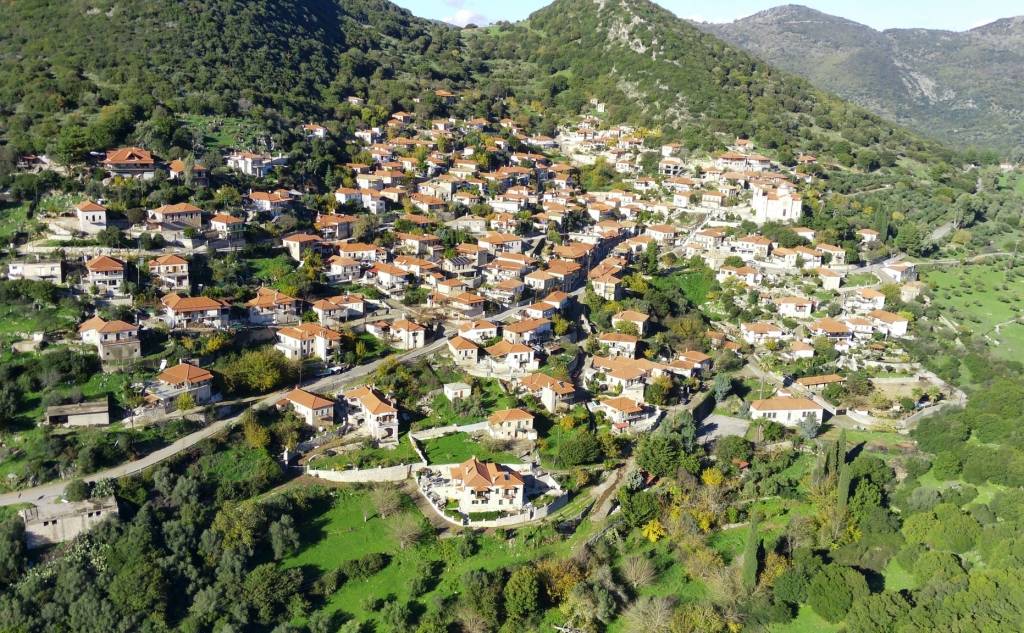
At the foothills of the mountain called "Castle", near the present-day village of Sidirokastro in Skorta of Arcadia or Arcάdia, that is, Trifylia, Messenia, the ruins of a great medieval fortress can be seen. The Castle of Sidirokastro, also known as lo castello de Ferro – Siderocastro, was an essential strategic centre in its time, as it controlled the mountain passes that connected Ilia with Arcadia.
There are two versions of the fortress's foundation. According to the first, the castle had already existed since the Byzantine period, surrounded by a large settlement whose ruins survive to this day. After the Fall of Constantinople in 1204, the Latins who occupied the Peloponnese established a garrison there and repaired the walls, integrating it into their defence organisation.
A second view, supported by the historian Panagiotis Konstantinidis, considers that the castle was built around 1210 by Geoffrey I of Villehardouin. He himself handed it over to the Barony of Akova, which had eastern Ilia and parts of western Arcadia under its control, with the Castle of Akova or Mategriffon as its centre. It is not excluded, however, that at times Sidirokastro was also under the influence of the Barony of Karytaina, which dominated western Arcadia, in the area known as "Skorta".
Sidirokastro is also mentioned in the Chronicle of the Moreas, a 14th-century medieval epic that describes the Franks' conquest and administration of the Peloponnese. There, it is presented as one of the key fortresses of the era.
In the mid-14th century, the castle came under the control of Zacharias Asanis (1346–1364), while in 1429 it belonged to Centurion I Zacharias, one of the last great feudal lords of the region. Later, Sidirokastro passed into Byzantine hands and became part of the Despotate of Mystras, under the rule of Thomas Palaiologos.
In 1460, after the Ottomans' final conquest of the Peloponnese, the castle was destroyed and deserted. Today, on the slopes of the mountain, parts of the walls, the fort's reservoir, and the ruins of two temples—Agios Ioannis and Taxiarches—are preserved, recalling the religious life of the medieval community.
The name Sidirokastro is not limited to Messenia. With the same name, we also find other castles in Greece: the Sidirokastro of Achaia, near the Monastery of Oblos, known as lo castello de Ferro sopra Patrasso, and the Sidirokastro of Central Greece, which was located in the Oiti mountain range.