

The custom of flying hot air balloons in Messenia


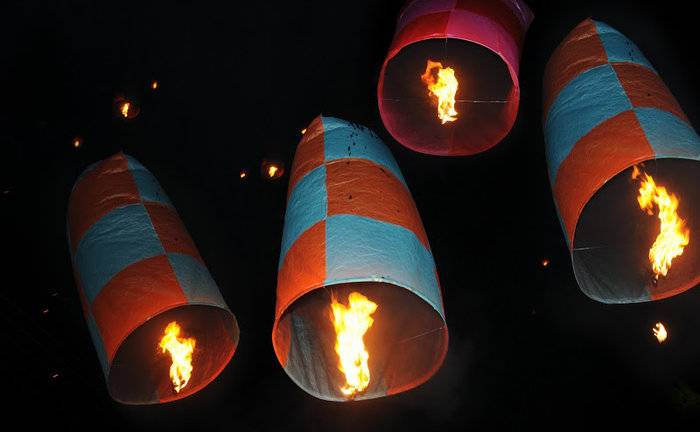
The custom of flying balloons appeared for the first time in Greece in 1835, with the arrival of King Otho, and its origins lie in distant China, in the form of a paper dragon. Gradually, the custom also reached Europe through the travels of Europeans to the East. The Bavarians flew balloons to show their submission to the king, so coming with Otto to Greece, they brought the balloon with them. The Greeks assimilated the custom, turning it into an event of joy.
According to the late folklorist Dimitrios Loukatos (1908-2003), the hot air balloon (like the kite) is a harbinger of Halloween and Spring, when the soul and spirit are fixed high towards the sky to be lost in infinity. Hot air ballooning is a way to "exorcise evil" and is considered one of the quintessential Messenian Halloween customs.
In Kalamata, the custom of flying the hot air balloon is revived every Ash Monday. More specifically, on Halloween Sunday, it takes place in Leika and on Ash Monday in Rachi and in Othonos Square (in the historic centre of the city), where hundreds of colourful balloons compose an impressive scene in the sky.
Balloons are made of reeds and paper sheets (just like kites) and can reach up to two metres tall! A rag soaked in oil and petroleum (stoupi) is used to ignite them. Just before the balloon is released into the sky, they light the stoupi after first placing it briefly over the fire to warm it up. Once the balloon is up, there is the traditional hunt by groups of children to catch it and bring it back.
Source: www.12dim-kalam.mes.sch.gr (12th All-Day Primary School of Kalamata)