

Nikitas Nifakos–Poet, Teacher


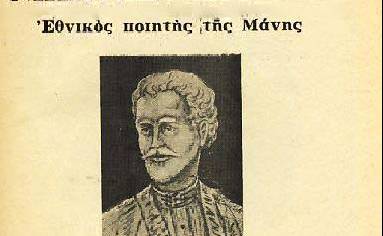
National poet Nikitas Nifakos was born in 1748 in the village of Milia (Milea):
"My most noble country,
generator, my breadwinner,
my beautiful town
Milea, my sweet light."
George's father was a priest, while his mother's name was Maritsa. At a young age, going to the village watermill to grind wheat, he was arrested in Agia Marina, Turkalvanoi, and taken to Mystras. From there, he was taken to Tripoli, Argos and Nafplio, where he was given a "peskesi" (gift) to the Pasha, who converted him to Islam and gave him the name Isbir. From Nafplio, the boy was taken to Thessaloniki, where the Pasha tried to introduce him to Islam. Afterwards, the Pasha gave him as a servant to his brother, and thus, he ended up in the city where he served in the Sarai. Nifakos finally managed to escape, going to Moldo-Vlachia. In Iasi, he was protected by a Greek priest named Nikiforos Theotokis. As a student, Nikitas Nifakos attended courses at the Hellenic Academy of Bucharest and, after graduation, returned to Constantinople, where he was appointed as an officer at the High Gate. Later, he served in confidential positions in Odessa and Smyrna and became a member of the Friendly Society alongside the grandson of Hegemonas Ypsilantis. In fact, in March 1797, he became an eyewitness to the burning of Fragomahala in Smyrna, describing the event in short quatrains:
"Sweet plains and mountains
far and near
and countries and villages
men and beasts.
Land and sea
and aerial birds
and stones and (the) woods
and the leaves of the trees.
Older people and little children
all to weep bitterly
the disaster that happened
in blackened Smyrna".
One day, Nifakos met a compatriot from the village of Pyrgos Lefktron in a Greek shop in the city and asked him about his family. He begged him, in fact, to go to his mother in Milies and tell her that he was fine. When his mother received her son's message, she put a lock of her hair in an envelope and sent it to him. From that moment, Nikiforos Nifakos' only desire and secret desire was to return to his homeland. Finally, he arrived in Mani around 1788, serving in the local lord Tzanetos Grigorakis or Tzanibei court. In 1813, he went to his birthplace and then to Kalamata, where he worked as a teacher.
From Socrates Nifakos (relative and biographer of the poet), we are informed that: "from the house of Tzanibei he visited all the villages of Mani and got to know the manners and customs of the Maniatians and wrote in politically symmetrical verses the History of Mani of all manners, villages and its "intradons" (products). Specifically, in the poem, there are many details about Mani's products, such as oil, cotton, prickly pears, and holly. At the same time, among other things, we learn that the villages of Mani are 117 and are divided into three areas (Kato Mani, Inside Mani, Outside Mani). The famous poem consists of 385 verses and was written at the end of the 18th century (1798), rendering with sufficient fidelity, humour, manic dialect and wordplay the topography of Mani.
Poet and lyricist Nikitas Nifakos passed away in 1818, leaving behind him a unique, for the time, poetic work which essentially contributed to the spiritual renaissance of Mani. His historical-political verse works are in fifteen-syllable or eight-syllable rhyming verse. In addition to the poem mentioned above, the following works of his stand out: "Farewell of Nikitos and Lamentation through verses of political homonyms" (1798), "Dialogues of teacher Nifos Nikitos and Kakavoulis of Spartiatus" (1808), "Discernment and hearing dialogue through verses of political homonyms" etc.
Nifakos' first work was published in fragments by the English traveller William Martin Leake in his "Travels in Morea" (vol. 1, London, 1830) and later in full by the Bavarian regent, Georg Ludwig von Maurer von Maurer) in his book "The Greek People". His Greek edition was published anonymously under the arbitrary title "Laconic Topography" (Athens, 1853). Finally, the entire work of Nifakis (2,845 verses) was published in 1946 by Vassilis Kougeas under the title: "Maniatika historical verse works" (Athens Academy Publications, 1946).