Point 7-The Route of N. Kazantzakis and the real George Zorba in Stoupa
Spread the word


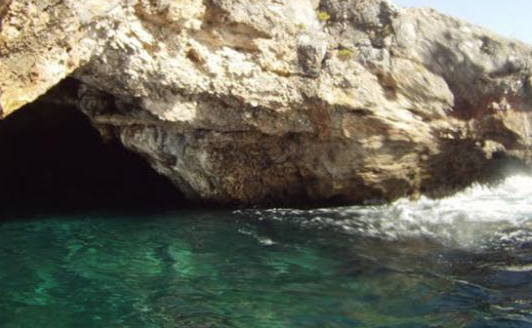


(Source: NARTURA, Cultural Association for Art & Nature)
On the southwestern curve of Kalogria Beach, where the eye meets the rock, and the waves carve memories into stone, lies Tourkospilia (Turks' Cave), an impressive sea cave accessible only by boat or by swimming, “like a small temple carved by Poseidon himself.”
The cave is not just a natural phenomenon but a living historical remnant. Its name comes from a dramatic episode in the 18th century: around 1775, Ottoman boats hid inside the cave, intending to launch a surprise landing in the area. But the local inhabitants, spirited and deeply familiar with the terrain, confronted them fiercely. The battle was violent, and the Ottoman defeat devastating.
From that moment on, the area became known as Golethros, meaning “land of destruction,” named after the catastrophic ruin suffered by the invaders. The toponym endured, and the cave secured its place in local historical consciousness, as well as in the region's mythology.
Poetic recitations inside a cave of echoes
Centuries later, Tourkospilia welcomed different visitors, poets instead of warriors. Nikos Kazantzakis and Angelos Sikelianos would often approach the cave by boat. Once inside, they would begin reciting poetry aloud. Their words echoed across the damp curves of the rock walls and acquired a different gravity. Sound itself became part of the creation, the landscape co-authoring the experience.
There, beneath the stone and before the light piercing through the cave’s opening, the two men seemed transformed: one, a disciplined thinker, the other, a prophet of Greek grandeur. The caves became their chambers, the rocks their audience.
Sikelianos and fishing, poetry cast into the sea
Beyond being a poet, Angelos Sikelianos was also a lover of nature and the senses. Locals would often see him casting a fishing line into the seaweed-rich waters in front of Tourkospilia. He fished with patience and silence, not merely for the joy of the catch, but for the connection with the marine world, that eternal Greek element.
Kazantzakis accompanied him at times, though fishing was never truly his path. He immersed himself not in the sea, but in thought. He sought the same fish in ideas, contemplation, and on paper.
Instead of a harpoon, an inkwell of words
Where Sikelianos pulled fish from the water, Kazantzakis drew words from the depths of his mind.
One captured life.
The other captured meaning.
And Tourkospilia, silent yet complicit, kept their secrets.
Tourkospilia is a resonant vessel of memory.
It is a cave that witnessed defeat, and a cave that sheltered poetry.
Here, war and inspiration coexisted, destruction and creation, danger and contemplation.
And if today you glimpse it from afar, like a narrow fissure in the rock, do not pass it by.
Keep your voice low.
Perhaps, if you stand at its entrance, you may still hear the echo of a recitation from another age.