

Point 8-The Route of N. Kazantzakis and the real George Zorba in Stoupa


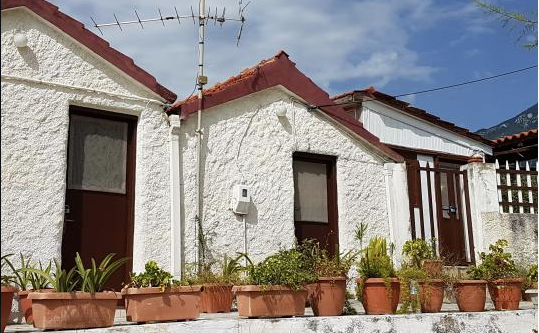
(Source: NARTURA, Cultural Association for Art & Nature)
Within the simplicity of a small stone dwelling, behind the dust of passing years and the salt of memory, a moment of life remains hidden. This was the little house of Nikos Kazantzakis, where the writer lived for a time during his stay in Stoupa, a place that gradually became more intimate to him than even his birthplace.
It was not meant to be a permanent residence, but rather a place of rest. It was during the period when Kazantzakis wished to host his beloved friend and spiritual companion, and he sought something more substantial than his makeshift hut.
Excerpt from a letter to Zorbas
“Dear Zorbas,
On Saturday, I arrive with my best friend. I will give him my little house (shack) so that he may sit alone there.
For me, the best solution would be to help me rent, for three months, the little house of the Exarchouleas family at Prinkipas.
Pay them the three months in advance, eight to ten drachmas per month, have it whitewashed, and let me stay there.
Otherwise, a room in your house temporarily.”
His writing is simple, everyday, almost intimate. And yet it radiates sensitivity and care, especially for his friend.
The House of Zorbas, a warm hearth of life
A few metres uphill from Kazantzakis’ little house stood the home where Georgis Zorbas lived with his family. It was a large, spacious, two-storey building, the home of his brother-in-law, Andreas Exarchouleas. Though the house no longer survives, in collective memory it remains alive with noise, children’s laughter, conversation, and warmth.
As the head of a large household, Zorbas sheltered not only six of his eight children, but also his wife’s widowed sister and her children. The house overflowed with voices, movement, wool caps, scarves, cooking pots, and welcoming glances.
Two worlds, two homes, one profound friendship
Kazantzakis’ tiny dwelling and Zorbas’ large family house, two completely different spaces, symbolised two entirely different worlds.
One was austere and Spartan, shaped for the man who lived within himself.
The other was overflowing with life and everyday humanity, shaped for the man who lived among others.
And yet, between those walls grew one of the most sincere friendships in modern Greek history. Kazantzakis, introspective and contemplative, found in Zorbas something unpretentious, authentic, and deeply human. Zorbas, practical and fiery, saw in Kazantzakis a friend who allowed him the freedom to be entirely himself.
Houses that became symbols
Today, those houses may no longer stand. Yet their spirit still lingers in the air of Stoupa. It walks through the stone alleys, wanders along Kalogria Beach, and enters the dreams of those who love language and truth.
In that corner of the earth, Kazantzakis found more than a shelter.
He found the man who inspired what may have become his greatest book.
He found the place that helped him lower his voice and hear, more clearly, the language within himself.
He found, for a brief time, a home within the world and a friend with whom to share food, daily life, and silence.
And the world, from that small corner of the earth, became a little more human.