Point 2-The Route of N. Kazantzakis and the real George Zorba in Stoupa
Spread the word


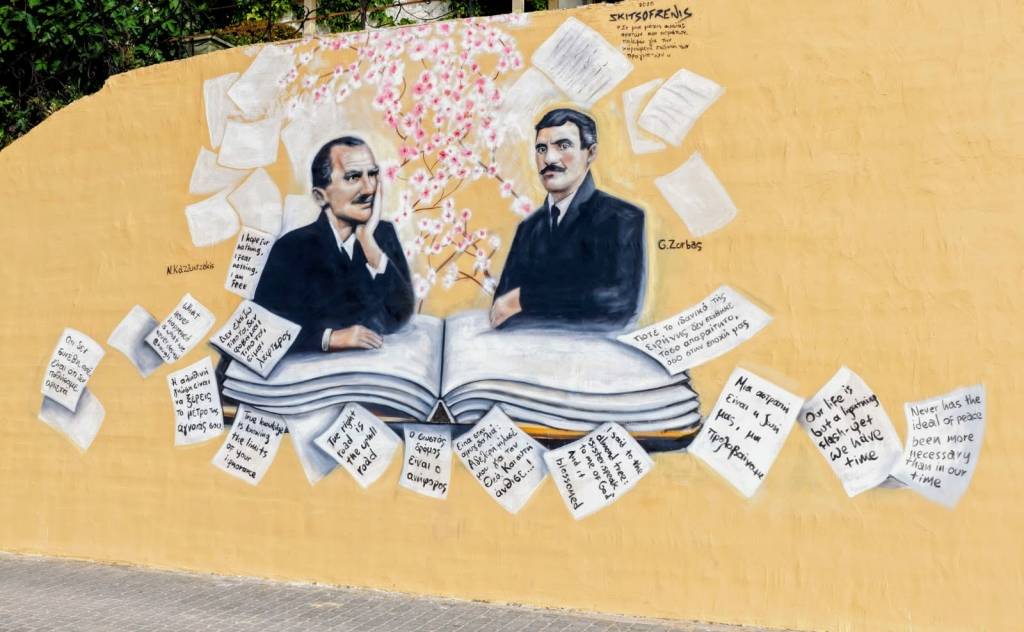


(Source: NARTURA, Cultural Association for Art & Nature)
At the southern edge of the beach in Stoupa, where the sea seems to listen to the stories of the past, a work of art speaks louder than words: a mural dedicated to Nikos Kazantzakis and Georgis Zorbas. One was a thinker and intellectual. The other, a man of folk wisdom, a free spirit passionately devoted to life. Two men from entirely different worlds met here, in the land of Mani, and profoundly changed one another forever.
Kazantzakis & Zorbas, A Living Contrast
The mural portrays more than two faces, it reveals two universes. Kazantzakis, with his deep gaze, appears burdened by ideas and existential quests. Zorbas, stripped of all theory, lives through instinct, flesh, emotion, and ecstasy, radiating pure vitality. They could not have been more different, yet it was precisely this contrast that created the spark between them.
Their time together here was not merely professional, though they worked side by side at the lignite mine of Prastova. Above all, it was spiritual, a kind of apprenticeship in freedom. Kazantzakis discovered in Zorbas the raw wisdom of a man who had never studied philosophy, yet had fully lived it. Zorbas, in turn, saw in Kazantzakis a friend, a brother, someone who truly understood him.
Inspiration for Immortality
This relationship would later become immortal through the masterpiece Zorba the Greek, first published in Paris in 1947 under the original title Life and Times of Alexis Zorbas. The character of Zorbas feels so vividly alive in the novel because he was real. His voice, his dancing, his explosive laughter, his tears, and his almost religious love of life were all born here and etched forever into world literature.
The mural is therefore far more than a work of art. It is a window into an era, a place, and a friendship that changed the course of Greek and international literature.
Standing before it, visitors do not simply see two figures. They witness the transformative power of human connection. They see how life, even if shared for only two years, can create eternity. And they understand why Kazantzakis once wrote:
“If I were born again, I would want to be once more with Zorbas.”
The Real Zorbas, The Man Behind the Myth
Before he became a novelistic hero, a theatrical character, a cinematic icon, and a global symbol of freedom and joy, Zorbas was a real man. Flesh and blood, sweat and passion, laughter and grief. His name was Georgis Zorbas, born in 1865 in Kolindros of Pieria, in northern Greece. He grew up in the mountain village of Katafygi in Kozani during the difficult years of Ottoman rule. He was the son of Fotis Zorbas and Evgenia Spanou.
Coming from a large family with three siblings, Giannis, a doctor, Xenophon, an engineer, and Katerina, Zorbas chose another path: the road of experience and hard labour. As he himself reportedly said:
“I learned every trade of the mind and the feet.”
And he truly had.
The Miner Who “Heard” the Earth
His life brought him to the mines of Chalkidiki, where he earned unusual respect among miners. He understood the earth instinctively. When he struck the ground with his hammer, he seemed to know exactly what lay beneath. He rarely made mistakes, and his fellow workers trusted him completely. Zorbas was an authentic folk philosopher shaped by labour, intuition, and experience.
Love, Marriage, and Loss
As a young man, he fell passionately in love with Eleni Kalkouni, the sixteen-year-old daughter of a mine supervisor. He eloped with her and married her. Eleni, a strong and spirited woman, gave him eight children, though two died young. Her death from tuberculosis at the age of thirty-three deeply marked him. Despite his later romantic adventures, Zorbas never remarried. Eleni remained the great love of his life.
Zorbas in Stoupa, Passion for Life
In 1917, Zorbas arrived in Stoupa at the invitation of Kazantzakis to work as chief foreman at the Prastova mine. He came with six of his children and settled near the beach of Kalogria Beach. There, in a small house by the sea, a legendary friendship was born.
Zorbas quickly became a vivid presence in the village. A lover of celebration, music, and dance, he energised the community, especially during Carnival festivities in 1917, when dressed as a gambler, he entertained everyone with theatrical antics. Though a free spirit, he never openly clashed with local society. He had his own discreet ways, occasionally travelling to Kalamata claiming “a material is missing,” while actually visiting the city’s entertainment district. He knew how to live and how to answer to no one.
The End of His Journey
The final chapter of his life unfolded in Skopje, where he eventually acquired his own mine. During World War II, when Nazi forces confiscated it, the injustice devastated him. He died soon afterwards, consumed by sorrow. His grave lies in the Butel Cemetery of Skopje.
His descendants still live in Greece and North Macedonia. Among them was Pavlos Sidiropoulos, the iconic Greek rock artist who was Zorbas’s great-grandson through his daughter Tasia, as well as musician Nikos Kehagiás.
Brotherhood Between Two Men
Kazantzakis and Zorbas had first met at Mount Athos. The writer immediately recognised in Georgis a man of explosive temperament, authenticity, and lived wisdom. He invited him to Mani and never regretted it.
Living together, they became inseparable, almost like brothers. When Kazantzakis learned of Zorbas’s death in 1941, the loss affected him profoundly. While living later on Aegina, he began writing the novel that would immortalise his friend.
Mani had remained in his memory like a blazing dream. Twenty-five years later, the place, the moments, and Zorbas’s gaze were still alive within him.
“Zorbas taught me to love life and not fear death… If I had to choose a guru in the whole world, I would choose him.”
Dance, The Language of the Soul
Zorbas himself answered life in his own unforgettable way. In the novel, he cries out to his “boss”:
“I never loved a man as I loved you… So now I shall dance! Step aside before I trample you!”
And then, with a leap, his arms and legs become wings. A rebellious archangel, this is how Kazantzakis saw him, and how the world remembers him.
From Georgis to Alexis, And Then to the World
Originally, the hero in the novel bore the name Georgis Zorbas. But after legal objections from Zorbas’s son Andreas, Kazantzakis changed the character’s name to Alexis, meaning “the one who resists.”
The story reached worldwide audiences through the 1964 film Zorba the Greek by Michael Cacoyannis. Anthony Quinn portrayed Zorbas with such force that the character became an eternal symbol of the Greek spirit. The music of Mikis Theodorakis, especially the globally famous syrtaki dance theme, forever linked Zorbas with a universal image of freedom and joy.
Bouzouki, Not Santouri
In the novel, Zorbas plays the santouri. In reality, however, the real Zorbas played the bouzouki, and played it well. Perhaps Kazantzakis chose the santouri for its more lyrical and mournful sound, better suited to express longing and loneliness.
Why Crete Instead of Mani?
In the book, the story is relocated to Crete. Yet the real events happened here in Mani, in Stoupa, on Kalogria Beach, and at the lignite mines of Prastova.
When asked why, Kazantzakis replied:
“In Mani, I met marvelous people, but I lived there only briefly. Crete, I know deeply, I carry it inside me.”
Perhaps he chose Crete not to conceal the truth, but because every writer ultimately rewrites life in the landscape where the heart beats strongest.
Here in Stoupa, beneath the same sun that once illuminated their faces, visitors can still sense the presence of Georgis and Nikos, not as myths, but as human beings who together created one of the most powerful songs ever written about life, death, and freedom.
♦ ♦ ♦ The mural was created in May 2026 by artist Kostas Louzis, also known as “Skitsofrenis.” One hundred and nine years after the brief stay of Kazantzakis in this place, and the friendship he developed with Giorgis Zorbas (1917-2026), the two figures now coexist once again in the very location where Zorbas encountered immortality.
The work is located at the southern end of Stoupa Beach. The initiative belongs to the cultural association NARTURA, in collaboration with the non-profit organisation KALLIERGON syn as part of the MANI | Kazantzakis – Zorbas Project. The project was also supported by the Municipality of Western Mani, the Neochori-Stoupa Community, Marielle Thomas, the General Director of UHU BISON, and local professionals of Stoupa.